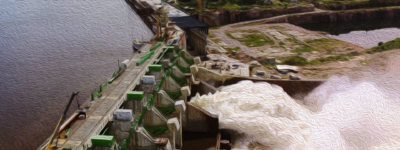
A solitary block of concrete, barely protected from flood by sump pumps, lies in the waters of the lower Caroní River. This is the case of the planned Manuel Piar hydroelectric plant in Tocoma, southern Venezuela, after paying US$ 10 billion —three times the budget and partly with funds from multilateral agencies— to several contractors, including the controversial Brazilian construction company. Of that amount, at least US$ 1 billion corresponded to irregularly paid foreign currencies through an administrative scheme (80-20, they called it) that an internal audit found, which was used to finance commissions to project management.

The network of intermediaries contracting with the Venezuelan Foreign Trade Corporation (Corpovex) to bring CLAP boxes seems infinite. In Sabadell, a town near Barcelona, a virtually cash shell company got 70 million dollars for outsourcing the shipment of food to Venezuela thanks to the administration of Nicolás Maduro, which buys the contents of the boxes at discretionary prices and without control. Last year alone, the government spent 2,500 to 3,500 million dollars, but only the leaders of the "Bolivarian revolution" know the actual figure.

The former Vice President of Finance and director of the state oil company was one of the executives in the industry with more charges and accusations. In 2006, the Office of the Comptroller opened a proceeding against him for not filing the sworn statement of assets. In 2011, he became noticeable for his alleged participation in the Ponzi scheme of Francisco Illaramendi. In 2009, four years after having him as a client, Mossack Fonseca learned that he was a Politically Exposed Person, but maintained the business relationship because no "links to illegal activities" were found.
Venezuelan Álvaro Gorrín escaped on his yacht in 2009 after the intervention of Banco Canarias, but he and his board members did not resign themselves to losing everything to the Venezuelan government. Between the support of an influential New York law firm and the expertise of Appleby to create companies in tax havens, the then fugitive from the Venezuelan justice drew a strategy to rescue something from the ruins.

In the Bolivarian Revolution of Venezuela, which has a strong military component, military officers can act, simultaneously or progressively, even in contravention of the law, as troops leaders, government executives and even state contractors. One in three of the 785 military officers active in their time who, as private, contracted with the public administration during the last ten years, did it from companies that have the social purpose of construction. One case stands out: Major General Frank Herbert Lynch Dávila. The family company of which he is part has received contracts for construction works for years while the officer escalated positions until being in charge of the cement supply throughout the country.

The country with the largest oil reserve in the hemisphere neglects its people with HIV-positive and lets them die. Since 2012, medicines are scarce and the pandemic is spreading unabated in Venezuela. That is why dozens of patients have embarked on a 4,000-kilometer epic journey in order to save their lives and reach for the promised land where they will find both employment and health.

The murder of two young entrepreneurs committed in Caracas last May transcended the police report sections and gained an international echo inasmuch as one of the victims was related to a 'celebrity' in the fashion industry, Carolina Herrera, the Venezuelan designer with the most global recognition. But the plot, also international, ended up highlighting the violent interlacings of the dispute over the control of the furtive foreign exchange business that operates between Florida and Venezuela

From being recognized in Margarita Island as the heir of the picturesque “Ranchos de Chana” (Chana’s slums) he has come to raise a different reputation outside Venezuela. In Miami, Florida, land of the Cuban exile and more recently of the Venezuelan exile, Pedro José Castillo Uzcátegui presents himself as a visionary business man, although in practice he has become a professional scammer.
A handshake between Hugo Chávez and Jiang Zemin, President of China, sealed a commercial relationship between Caracas and Beijing that totals two decades of cooperation marked by thousands of dollars and debts, half efficiency, and much opacity. Now, hundreds of official documents obtained by Armando.info and processed together with the Latin American Center for Investigative Journalism (CLIP) reveal, through a series of stories, how this exchange flowed, which was not always advantageous for Venezuela.
Read serie