Aside from ethical questions, the logic of a private entity opening an offshore company seems elementary —to declare its profits in a territory where it can pay less tax than it should in its place of origin. But when it comes to a state-owned company like Petróleos de Venezuela, which is not obliged to pay taxes - and therefore does not need to evade them - it is difficult to understand why within its business scheme there is contracting with companies established in tax havens and there is even the creation of their own subsidiaries in these places. What does the Venezuelan public treasury gain from this?
In two countries of "Bolivarian" regimes, Ecuador and Venezuela, Chinese investment has found avid business partners over the last ten years. The Asian giant has injected vast financial resources and resources for infrastructure works into both nations, many of them unfinished. But the other side of the coin is the conditions imposed on the partners in draconian contracts that the Chinese entities and companies have subscribed by their local counterparts. In the height of the 21st Century, the foreseeable power of the future imposes terms and conditions of the 19th Century, like the suspension of labor laws, importation of labor, exclusive use rights, more expensive financing, payments in foreign currency, among other nineteenth-century privileges.
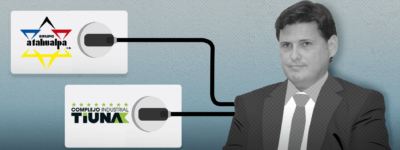
In business, the entrepreneurs who have amassed fortunes to the rhythm of the schizophrenic chavista economy stand out. A Peruvian-Spanish citizen has developed a real emporium in the last 13 years. Once pointed out as the potential financial channel between the Venezuelan government and the Spanish political party Podemos, it could only be confirmed that he works shoulder to shoulder with the military and every day incorporates new businesses to his emporium. Atahualpa Fernández continues to gain ground among the entrepreneurs protected by the ruling party.
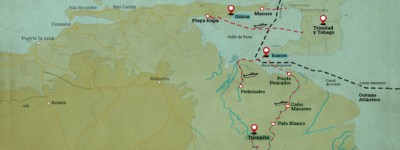
Since the borders to Colombia and Brazil are packed and there is minimal access to foreign currency to reach other desirable destinations, crossing to Trinidad and Tobago is one of the most accessible routes for those in distress seeking to flee Venezuela. Relocating them is the business of the 'coyotes' who are based in the states of Sucre or Delta Amacuro, while cheating them is that of the boatmen, fishermen, smugglers and security forces that haunt them.

Odebrecht was not the only one. Four companies were awarded a dozen works to build large infrastructures in Argentina, nearly always using the gimmick of an attractive quote and the accompanying financing by a Brazilian state development bank. However, they subcontracted other providers afterward and, with the projects already in progress, the costs increased and the Argentine State ended up providing the funds, over US$ 9,000 million, of which an average of 300 million per work corresponded to surcharges. In addition, today many of the projects remain unfinished. The pattern would be used by Brazilian construction companies in other Latin American markets.

Mundo Digital USA, a company created in Florida, and related to another company based in Madrid, is using almost all the Venezuelan musical heritage after a suspicious and unclear operation. This is a situation derived from the paradigm change of consumption of songs and a certain indifference on behalf of the main record labels and those in charge of their labels, who failed to notice ahead of time the changes bequeathed by technology. The affected - singers, composers - remain the usual victims. The money they should receive for their creations arrives incomplete and sometimes it never does at all.

Armando.info publishes an excerpt from the extended edition of “Los brujos de Chávez” (Chávez’s warlocks and witches), the lauded book by David Placer, a Venezuelan journalist based in Spain, published in Venezuela by the publishing company Editorial Dahbar. The chronicle shows what could be the highlight of the Chavista Santeria, the exhumation of the remains of Simón Bolívar, ordered by the late president commander because he was determined to prove that the Liberator had been poisoned in San Pedro Alejandrino. From there, Placer cites episodes and talks with witnesses in Miami and Caracas, who claim that Chávez became a santero (practitioner of Santeria) before assuming the presidency for the first time in 1999. With his research, Placer completed a deliberately hidden aspect of the volcanic life of the leader of the Bolivarian process.

In Venezuela, less than fifty military officers are entrusted the mission of administering justice to their military counterparts. But as the Government of Nicolás Maduro sends more political dissidents and insubordinate civilians to be tried in that jurisdiction the weakest flanks of a lodge of judges arbitrarily appointed by the Ministry of Defense, who have unclear merits and a clear willingness to follow orders, are more evident.
A handshake between Hugo Chávez and Jiang Zemin, President of China, sealed a commercial relationship between Caracas and Beijing that totals two decades of cooperation marked by thousands of dollars and debts, half efficiency, and much opacity. Now, hundreds of official documents obtained by Armando.info and processed together with the Latin American Center for Investigative Journalism (CLIP) reveal, through a series of stories, how this exchange flowed, which was not always advantageous for Venezuela.
Read serie