For some months now, parliament members of different opposition political parties have been offering to make informal proceedings on request before agencies like the Colombian Attorney General's Office and the United States Department of the Treasury. They issue letters of good conduct to those responsible for negotiations on the imports for CLAP combos, so that such agencies absolve or stop investigating entrepreneurs like Carlos Lizcano, a subordinate of the already sanctioned Alex Saab and Alvaro Pulido. The fact that the most active defense of the main social program and focus of corruption of the government of Nicolas Maduro comes from the heart of the National Assembly 'in contempt' is just one of the ironies of this story.

Sometimes intermediary, others, supplier, but always omnipresent, this Venezuelan is one of the most active and unknown person in the registration of companies in tax havens of the Caribbean. Many of these companies were incorporated ad hoc to do business with Corporación Casa, a food import state entity.
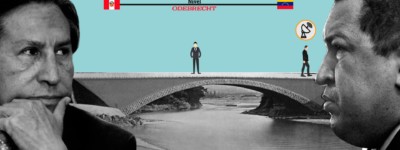
Two entrepreneurs from Peru, Yosef Maiman and Sabih Saylan, participated as intermediaries in the irregular payments of Odebrecht, through offshore structures, to the former president of that country. They are part of a "shell companies" structure built by Mossack Fonseca, as shareholders of the private cable TV and telephone operator in Venezuela, Inter. Even the Panamanian law firm suspected that it was being used for money laundry. Meanwhile, another firm of the group contracted works with the Chavista State.

Odebrecht was not the only one. Four companies were awarded a dozen works to build large infrastructures in Argentina, nearly always using the gimmick of an attractive quote and the accompanying financing by a Brazilian state development bank. However, they subcontracted other providers afterward and, with the projects already in progress, the costs increased and the Argentine State ended up providing the funds, over US$ 9,000 million, of which an average of 300 million per work corresponded to surcharges. In addition, today many of the projects remain unfinished. The pattern would be used by Brazilian construction companies in other Latin American markets.

Turkey and the coastal emirates of the Arabian Peninsula are now the homes of companies that supply the main social -and clientelist- program of the Government of Venezuela. Although the move from Mexico and Hong Kong, seems geographically epic, the companies has not changed hands. They are still owned by Colombian entrepreneurs Alex Nain Saab Morán and Álvaro Pulido Vargas, who control since 2016 a good part of the Import of food financed with public funds. Around the world for a business.

Since its opening in 2017, the Porsche Design Tower quickly became a symbol of luxury and ostentation in South Florida. Magnates from all over the world retreat behind the discretion of its tinted glass windows and virtually anonymous legal entities. But in recent days, two police investigations into illegal financial flows from abroad placed the building under an inconvenient spotlight. The justice just seized an apartment of over five million dollars from a Venezuelan agent.
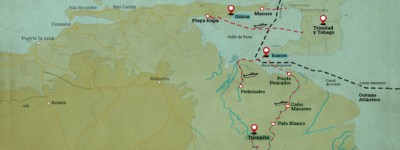
Since the borders to Colombia and Brazil are packed and there is minimal access to foreign currency to reach other desirable destinations, crossing to Trinidad and Tobago is one of the most accessible routes for those in distress seeking to flee Venezuela. Relocating them is the business of the 'coyotes' who are based in the states of Sucre or Delta Amacuro, while cheating them is that of the boatmen, fishermen, smugglers and security forces that haunt them.
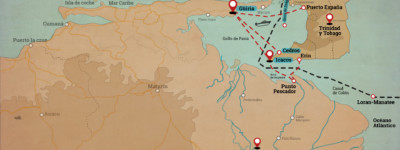
Without human rights officers at the ports of entry or legal system that protects the refugee, Venezuelans migrating to the Caribbean island find relief from hunger and shortages. In return, they are exposed to labor exploitation and the constant persecution of corrupt authorities. On many occasions they end up in detention centers with inhumane conditions, from which only those who pay large amounts of money in fines are saved. The asylum request is a weak shield that hardly helps in case of arrest. Yet, the number of those who try their luck to earn a few dollars grows.
A handshake between Hugo Chávez and Jiang Zemin, President of China, sealed a commercial relationship between Caracas and Beijing that totals two decades of cooperation marked by thousands of dollars and debts, half efficiency, and much opacity. Now, hundreds of official documents obtained by Armando.info and processed together with the Latin American Center for Investigative Journalism (CLIP) reveal, through a series of stories, how this exchange flowed, which was not always advantageous for Venezuela.
Read serie